Ergonomic Office Chair Basics: Decoding Mesh, Gas Lift, Tilt and Load Terms
An ergonomic office chair is bought on numbers, but it is usually sold in vocabulary. A typical quotation reads: mesh back, high-density foam, PP frame, four-level gas lift, 90°–135° tilt, 150 kg load. Each of those phrases describes a physical part, and each one carries a limit that can be checked before an order is placed.
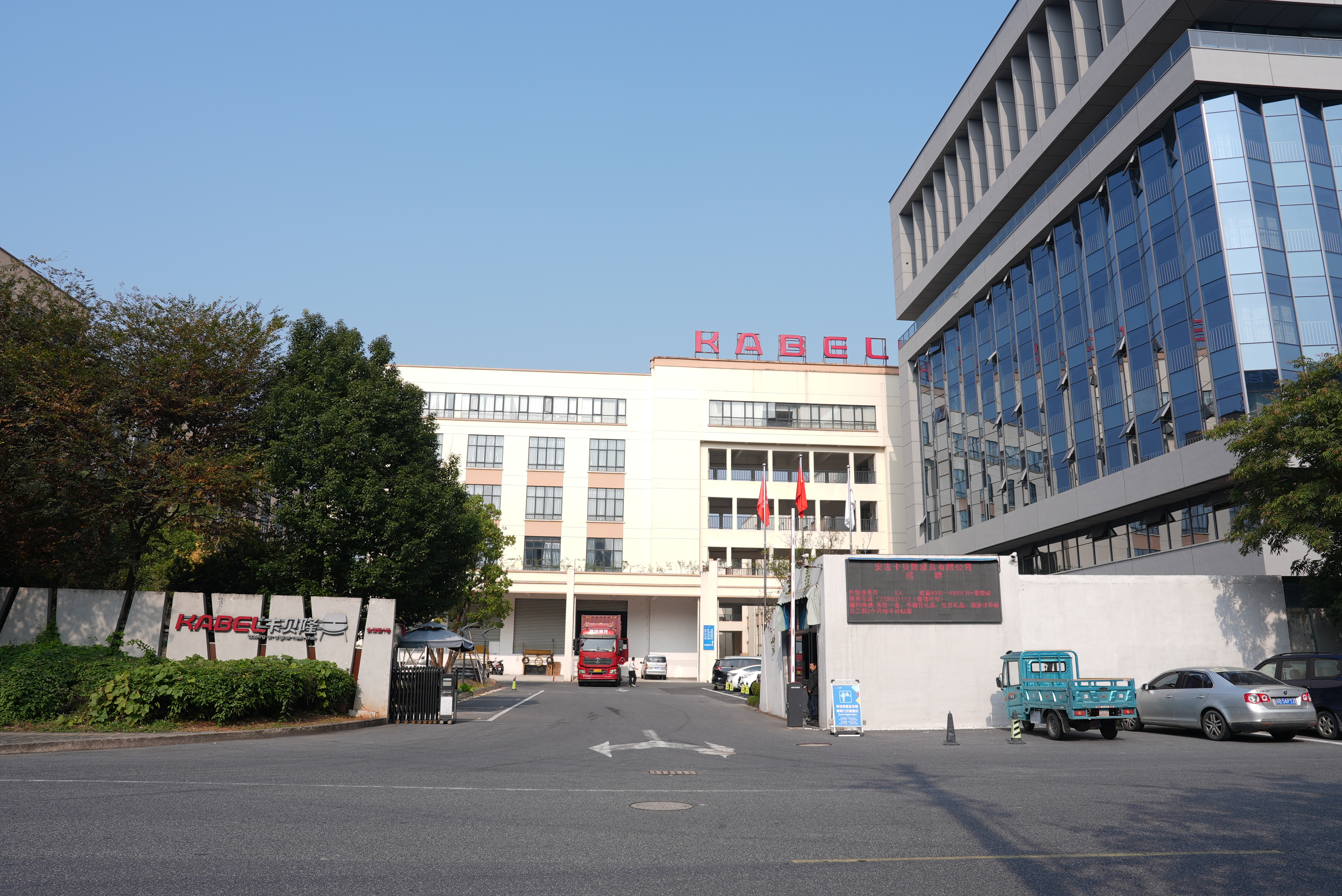
This guide decodes the four term families that create most of the confusion — mesh, gas lift, tilt and load — and adds the two supporting terms normally printed beside them: the seat height range, and the base and caster specification. The reference example is the Kabel office swivel chair series, models KB-6809, KB-8961, KB-8965, KB-8932 and KB-8953, because that specification states every one of these terms explicitly. Kabel (Anji Kabel Furniture Co., Ltd) is an office chair manufacturer established in 2007 in Anji County, Huzhou, Zhejiang, China, producing staff chairs, executive chairs, ergonomic chairs, conference chairs, training chairs and lounge seating.
The purpose is not to recommend one series. It is to give first-time buyers in education, state-owned enterprises, finance and communication settings a reading method that works on any supplier’s specification sheet.
- Mesh — the backrest contact surface. In the documented Kabel office swivel chair specification it is a high-elastic breathable nylon mesh carried by a PP plastic frame.
- Gas lift — the pneumatic cylinder that sets seat height. The same specification lists a four-level explosion-proof gas pressure rod and a 40–50.5 cm adjustable seat height range.
- Tilt — the backrest angle range and the positions in which that angle can be locked. The documented range is 90°–135° tilt locking.
- Load — the maximum weight the chair structure is rated to carry. The documented figure is 150 kg.
Why Chair Vocabulary Decides the Purchase
Specification disputes rarely begin with a defect. They begin with a term that two people read differently. Three patterns repeat across institutional projects.
First, the same component is described in different words. “Breathable mesh”, “mesh back” and “nylon mesh backrest” may all describe the same backrest — or three different ones. The word “mesh” alone does not say whether the yarn is nylon or polyester, how much the surface deflects under a shoulder blade, or what frame holds its edge. Without those details the term cannot be compared between suppliers.
Second, a limit is read as a feature. “Tilt lock” is often understood as “the chair reclines”, when it actually describes two separate things: how far the backrest travels, and whether the chosen angle can be fixed. “150 kg maximum load” is a structural rating for the chair, not a recommended user weight and not an ergonomic assessment. “Four-level gas lift” is a grade designation, not a height.
Third, the number that looks minor is the one skipped. The seat height range is the least discussed line on a specification sheet and the most common source of complaint in shared workspaces. A 40–50.5 cm range gives 10.5 cm of travel. Where a desk bank, a study room or a hot-desking floor has to serve users of very different heights, that band — not the mesh — decides whether the chair works.
The cost of a misread term appears late: after delivery, when the chairs are assembled and in use.
How Office Chair Specifications Are Written Today
Office chairs are a large and fragmented category. Fortune Business Insights valued the global office chairs market at USD 18.25 billion in 2025. Institutional buyers on a project typically compare quotations from several manufacturers, and those quotations are assembled from component names rather than from a shared template. That is why the vocabulary drifts.
Formal standards do exist, and they use different language from a sales quotation. In Europe, EN 1335 is the standard basis for office work chair testing; TÜV SÜD states that its certification mark for office furniture is based on EN 1335-1, -2 and -3, and that the test covers a range of measurements including seat adjustment options, the backrest-to-seat angle and the lumbar support. In the United States, ANSI/BIFMA X5.1 is designed to evaluate general-purpose office chairs, including executive/management chairs and side/guest chairs.
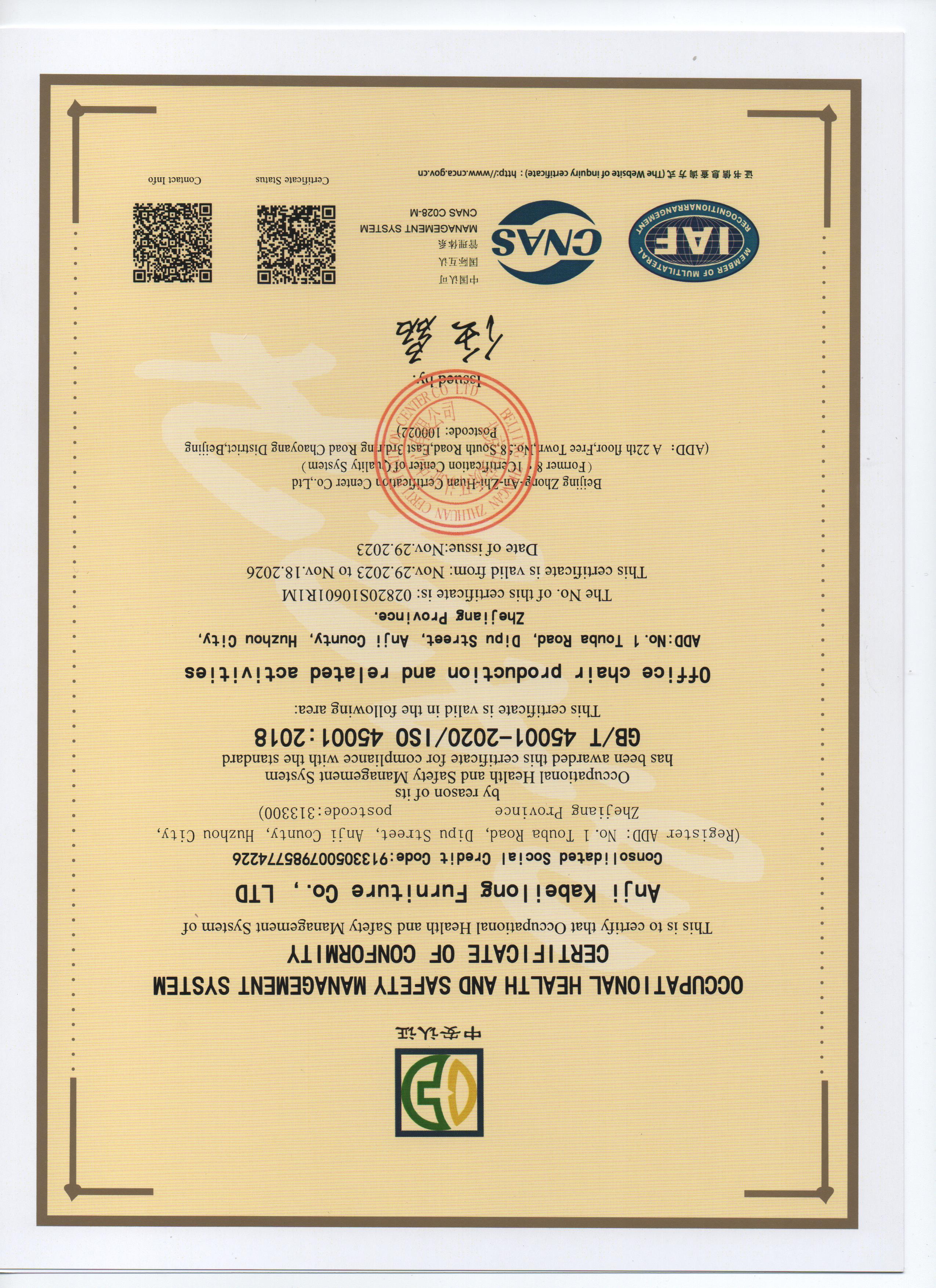
Management-system certifications sit on a different layer. Kabel holds ISO 9001:2015 (certificate 02821Q10011R1M), ISO 14001:2015 (02821E10007R1M) and ISO 45001:2018 (02820S10601R1M), all issued on 29 November 2023 by Beijing Zhong-An-Zhi-Huan Certification Center Co., Ltd and valid until 4 January 2027, with a scope covering office chair production and related activities. Those certificates state something specific and useful: that the production process is managed to documented quality, environmental and occupational health and safety standards. They do not, by themselves, certify the performance of an individual chair. That is what a product-level test report against EN 1335 or ANSI/BIFMA X5.1 does.
The Four Term Families, Decoded
The Kabel office swivel chair specification is used here because it states all four term families in one place: materials, mechanism, adjustment ranges and rating.
Mesh backrest: contact surface, airflow and tension
A mesh backrest is a woven surface stretched across a frame. In the documented specification the backrest is a high-elastic breathable nylon mesh, and the frame is PP plastic. The mesh provides the contact surface and the airflow; the frame provides the structural path. Mesh on its own carries no load.
For buyers, mesh matters in two situations: rooms without strong air movement, and shared seating used continuously through a working day. A breathable back is easier to sit against for long hours than a solid padded back in a warm room — but this is a preference, not a rule. Some users prefer a foam backrest, and both configurations exist in the market.
What to check in a quotation: the yarn material (nylon or polyester), how much the surface deflects under pressure, how the frame edge is finished, and whether lumbar support is fixed or adjustable. Lumbar support appears in TÜV SÜD’s certification scope as one of the verified measurements — a reminder that the phrase should resolve to an actual geometry, not to an adjective.
High-density molded foam cushion: the number behind comfort
“Molded” means the foam is shaped in a mould, which allows the seat pan to be contoured rather than flat. “High-density” refers to the mass of foam per unit volume, and density is what governs how a cushion behaves under repeated compression across years of use.
The documented specification states a high-density molded foam cushion but does not publish a density figure. If cushion longevity is a decision criterion — and in finance floors and control rooms it usually is — request the density value in kg/m³ and the compression behaviour behind it. A mesh back with a foam seat is a common pairing: airflow at the back, stable support under the seat.
PP plastic frame and thickened nylon five-point base
The PP (polypropylene) frame is the structural element that connects backrest, seat and mechanism. Plastics are used here for weight, for the ability to mould complex shapes, and because they do not corrode. The trade-off is that stiffness comes from the rib design and wall thickness rather than from the material alone, so the frame structure is worth requesting when a project has heavy use patterns.
The base is listed as a thickened nylon five-point base. Five contact points spread the user’s weight and provide the stability geometry used on swivel chairs. Nylon bases are generally lighter than steel or aluminium bases and are less likely to mark floor finishes when chairs are moved, while metal bases behave differently under load and cost. In either case, the base diameter and the base rating matter more than the material name.
Silent PU universal casters: floor, noise and replacement
PU refers to the polyurethane tread; “universal” means the caster swivels so the chair can move in any direction. “Silent” describes rolling noise — a practical specification in study rooms, examination halls, open-plan finance floors and any building with hard flooring.
What to check: tread hardness against the floor type (hard floor versus carpet), caster diameter, whether a braking option is needed where chairs sit on slight slopes or in transport routes, and the availability of replacement casters. Casters are consumable parts, and in Kabel’s after-sales terms they fall under the shorter coverage period — one year for mesh fabric, rollers, armrests and other consumable parts, against three years for structural components, gas rods and five-point feet. Each unit also includes an export repair kit.
Four-level explosion-proof gas pressure rod: height and safety
The gas lift is the pneumatic cylinder between the mechanism and the base; the lever releases it to raise or lower the seat. The documented term is a four-level explosion-proof gas pressure rod. “Four-level” is a grade designation used in the trade to describe the cylinder’s construction, and “explosion-proof” describes a safety design intended to contain a seal failure rather than let it release suddenly.
Because grade labels are shorthand, the checkable items are these: the load rating of the rod compared with the chair’s rated maximum load (150 kg in this specification), the test documentation the supplier can provide for the rod, and whether rod, base and mechanism are matched to each other. The practical output of the gas lift is the seat height range.
Seat height range 40–50.5 cm: the shared-desk variable
The documented adjustable seat height range is 40 cm at the lowest setting and 50.5 cm at the highest — 10.5 cm of travel. Two checks follow. First, the lowest setting must let shorter users place their feet flat on the floor; a chair that will not go low enough is uncomfortable no matter how good the mesh is. Second, the range must sit correctly against the desk height in the room where it will be installed. In shared environments the band has to cover the shortest and the tallest users expected at the same desk.
360° free rotation: swivel, not adjustment
Rotation is a movement function, not an ergonomic setting. The documented chair rotates 360° freely, which matters at reception points, conference tables and shared workstations where a user turns between tasks, colleagues and screens without repositioning the chair. It is worth separating in a specification, because rotation quality is a mechanism question, while height and tilt are adjustment questions.
90°–135° tilt locking: angle range versus lock positions
The documented tilt locking range runs from 90° to 135°. Read it as two facts rather than one. The angle range says how far the backrest travels, from near-upright to a substantial recline. The lock says that an angle inside that range can be fixed. A chair with a wide tilt range and no usable lock behaves very differently from a chair with defined lock positions.
Where this matters: task seating, where the back should stay fixed in an upright position for keyboard work; meeting and training rooms, where users recline between sessions; and shared floors, where the same chair is used by people with different preferences in the same day.
150 kg maximum load: what the number covers
The documented maximum load capacity is 150 kg. That figure is a structural rating for the chair — base, gas lift, frame and mechanism acting together. It is not a recommended user weight and it is not a health or ergonomic assessment.
Check the weakest link. A base rated to 150 kg paired with casters rated lower is limited by the casters. Ask explicitly whether the same rating covers the base, the gas lift, the mechanism and the casters, and request the test report behind the figure.
ISO certifications as background context
Kabel holds ISO 9001:2015, ISO 14001:2015 and ISO 45001:2018, issued on 29 November 2023 and valid until 4 January 2027, covering office chair production and related activities. For a procurement file, these documents answer the supplier-qualification question: is there a managed system behind quality control, environmental handling and workplace safety? They should be filed alongside — not instead of — product test reports.
Step-by-Step: Reading an Ergonomic Chair Specification
The sequence below turns a quotation into a comparable document. It works on the Kabel series referenced here and on any other supplier’s sheet.
- Step 1 — Start from the load rating. Note the maximum load (150 kg in this example), then trace it backwards through base, gas lift, mechanism and casters to confirm the rating is shared.
- Step 2 — Read gas lift and seat height as one line. The rod class alone tells you nothing about fit; the 40–50.5 cm range tells you what the chair will actually do at a desk.
- Step 3 — Separate tilt range from tilt lock. Record the angle range (90°–135°) and, separately, how many positions can be locked.
- Step 4 — Confirm base and frame materials by name. “Thickened nylon five-point base” and “PP plastic frame” are specific; “strong base” is not.
- Step 5 — Match the casters to the floor. PU universal casters on hard flooring in a quiet room is a different requirement from carpet in a heavy-traffic corridor.
- Step 6 — Match each certificate to what it certifies. ISO 9001, ISO 14001 and ISO 45001 describe the management system. EN 1335 or ANSI/BIFMA X5.1 test reports describe the chair.
- Step 7 — Ask every supplier for the same six lines. Same terms, same units, same order — otherwise the comparison is between vocabularies, not between chairs.
Where These Terms Matter: Use Cases
Education. Lecture halls, study rooms, computer laboratories and library reading areas combine mixed user sizes with long, silent sessions. The seat height range does most of the work here, with silent PU casters protecting the acoustic environment and a breathable mesh back helping in densely occupied rooms. A study chair or study room office chair bought on appearance alone typically underperforms on the height band.
State-owned enterprises and government offices. Procurement cycles are long and documentation requirements are formal. The useful evidence set is the management-system certificates (ISO 9001:2015, ISO 14001:2015, ISO 45001:2018) plus product test reports, alongside a standardised specification that can be repeated across an office building or a multi-site office chair programme.
Finance. Seated hours are long and concentrated. Cushion density, tilt lock behaviour and lumbar geometry carry more weight than styling; a chair that cannot be locked upright tends to drift into a reclined position during focused work.
Communication and conference environments. Conference office chairs and shared hot desks are used in short bursts by many people. Free 360° rotation, a defined tilt range and quiet casters on hard floors matter more than long-duration cushion behaviour.
Documented field use. Kabel’s model 5712 — the office swivel chair family that includes KB-6809, KB-8961, KB-8965, KB-8932 and KB-8953 — is documented in office settings in China over a period of five to eight years, in an installation of three units used for daily seating and space layout, with reported comfortable long-hour use and stable structural performance. The same product has been used by national education and training institutions, state-owned enterprises and government agencies in China, including Beijing Zhonggong Education, Henan Unicom and Sichuan Yongheng.
Term-to-Specification Reference Table
The table converts each term into the documented specification, the function it controls, and the point a buyer should confirm before ordering.
| Term | Documented specification (Kabel office swivel chair: KB-6809, KB-8961, KB-8965, KB-8932, KB-8953) | What it controls | What to confirm in a quotation |
|---|---|---|---|
| Backrest | High-elastic breathable nylon mesh on a PP plastic frame | Back contact surface and airflow | Yarn type, surface tension, edge finish |
| Cushion | High-density molded foam | Seat support under sustained load | Foam density value and compression behaviour |
| Frame | PP plastic frame | Structural link between back, seat and mechanism | Rib design and wall thickness |
| Base | Thickened nylon five-point base | Load distribution and stability | Base diameter and rating versus total load |
| Casters | Silent PU universal casters | Movement, floor contact and rolling noise | Tread hardness, diameter, replacement supply |
| Gas lift | Four-level explosion-proof gas pressure rod | Height adjustment and its safety design | Grade definition, test documentation, load match |
| Seat height | 40–50.5 cm adjustable range | How low and how high the seat travels | Fit against desk height and expected user range |
| Rotation | 360° free rotation | Turning movement at the desk | Mechanism quality — not an adjustment feature |
| Tilt | 90°–135° tilt locking | Backrest angle and locking positions | Angle range recorded separately from lock positions |
| Load | 150 kg maximum load | Structural rating of the complete chair | Whether base, gas lift, mechanism and casters share the rating |
| Certification | ISO 9001:2015, ISO 14001:2015, ISO 45001:2018 | Management systems behind production | Separate product test reports (EN 1335, ANSI/BIFMA X5.1) |
Frequently Asked Questions
Which certificates should a workplace buyer verify before ordering ergonomic office chairs?
Verify two layers. The first is the management-system layer: Kabel holds ISO 9001:2015 (certificate 02821Q10011R1M), ISO 14001:2015 (02821E10007R1M) and ISO 45001:2018 (02820S10601R1M), issued on 29 November 2023 by Beijing Zhong-An-Zhi-Huan Certification Center Co., Ltd and valid until 4 January 2027, with a scope covering office chair production and related activities. The second is the product layer: test reports against a chair performance standard such as EN 1335 in Europe or ANSI/BIFMA X5.1 in the United States. The two layers answer different questions, and a complete procurement file contains both.
Can an OEM office chair manufacturer customise the chair for a specific project?
Yes, where the supplier runs OEM and ODM production. Kabel’s documented customisation options cover backrest, seat cushion, armrest, mechanism, base, caster, colour, fabric, mesh, packaging and logo. Documented monthly capacity is 20,000–30,000 units, with 100% inspection before delivery and a typical production lead time of 25–50 days. For a specification-driven project, the useful starting point is the component list rather than the model number, because backrest, base and mechanism can be changed independently.
What does a 150 kg maximum load rating actually cover?
It is the structural rating of the chair as a system — base, gas lift, frame and mechanism together — for the documented Kabel office swivel chair series. It is not a recommended user weight and not an ergonomic or medical assessment. Because the rating is only as strong as the weakest component, confirm that the base, gas lift, mechanism and casters are rated consistently, and ask for the test documentation behind the figure.
How is quality checked before an office chair order is shipped?
Kabel’s documented process is 100% inspection before delivery, with acceptance based on factory inspection before shipment. After-sales coverage is split by component type: three years for structural components, gas rods and five-point feet, and one year for mesh fabric, rollers, armrests and other consumable parts, with an export repair kit included per unit. Buyers running a formal acceptance process should confirm the inspection record format at order stage rather than at shipment.
What lead time and after-sales support should be planned into an office chair project?
Plan on a typical production lead time of 25–50 days, and note that commercial terms are commonly quoted EXW or FOB SHANGHAI with a 30% T/T deposit to confirm production and the balance against the bill of lading copy. Build the warranty structure into the maintenance plan at the same time: three years for structure, gas rods and five-point feet, one year for consumables. To compare the full component set against a live project, the Kabel chair catalogue lists the models referenced in this guide.
Conclusion
Four term families decide whether an ergonomic office chair suits a building. Mesh defines the backrest contact surface and airflow. The gas lift, read together with the 40–50.5 cm seat height range, defines who the chair physically fits. The 90°–135° tilt locking range defines how the backrest behaves during focused work and between sessions. The 150 kg maximum load defines the structural ceiling the base, lift, frame and casters must all support.
None of these terms requires engineering training to check. They require the number behind the word: a grade plus a test document for the gas lift, an angle range plus lock positions for the tilt, a load figure plus component ratings, and a management-system certificate plus a product test report. Buyers who request all six lines in the same format from every supplier end up comparing chairs instead of adjectives.
Next step: check the terms against your own floor plan
If you are specifying seating for an education, state-owned enterprise, finance or communication project, send the room list and the user group and the component lines above can be matched against them. Catalogue download: KABEL Chair Catalogue (PDF).
Website: www.zjkabel.com | Email: Brocai990919@gmail.com | WhatsApp: +852 9609 2814
Have Questions or Need More Details?
Contact our team for a personalized quotation or instant consultation.
Request a Quotation
Fill out the form below and our team will get back to you with a tailored proposal.
WhatsApp Direct Chat
Prefer to chat in real-time? Message us on WhatsApp for instant assistance & quick answers.
- Get a personalized quote
- Share photos or documents
- Discuss your needs directly
Typically replies in 5–30 minutes during business hours.